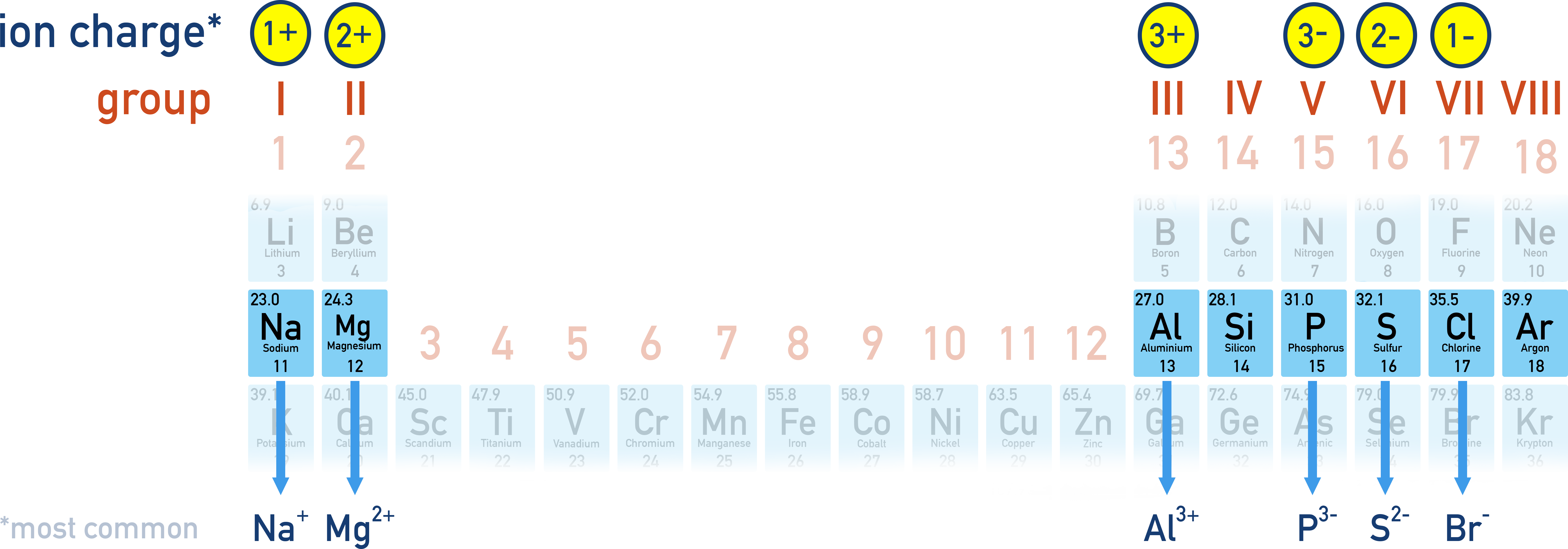

If you’ve ever stared at the Periodic Table and wondered why some elements seem to stick together while others repel each other, you’re not alone. I’ve spent years teaching chemistry, and one of the most common questions I get is about the Periodic Table with their charges. It’s not just a grid of symbols and numbers—it’s a roadmap to understanding how elements interact. Here’s the thing: the charges of elements are tied to their electron configurations, which are neatly organized in the Periodic Table. Once you grasp this, chemistry starts to make a lot more sense.
Why Charges Matter in the Periodic Table
Charges are the backbone of chemical reactions. When elements gain or lose electrons, they form ions, which are essential for bonding. The Periodic Table isn’t just a list of elements; it’s a tool that predicts how they’ll behave based on their position. For example, elements in Group 1 (alkali metals) tend to lose one electron, giving them a +1 charge. On the flip side, elements in Group 17 (halogens) often gain one electron, resulting in a -1 charge. This pattern repeats across the table, making it easier to predict charges without memorizing every single one.
How to Determine Charges Using the Periodic Table
Determining charges isn’t as hard as it seems—if you know where to look. Here’s a step-by-step guide:
- Identify the Group Number: The group number often corresponds to the number of electrons an element will gain or lose. For example, Group 2 elements (alkaline earth metals) typically lose two electrons, giving them a +2 charge.
- Check the Period Number: While the period number doesn’t directly determine charge, it helps you understand the element’s electron shell structure, which is crucial for predicting reactivity.
- Look for Transition Metals: Transition metals are trickier because they can have multiple charges. For instance, iron can have a +2 or +3 charge depending on the compound it forms.
- Use the Octet Rule: Elements often gain or lose electrons to achieve a full outer shell (eight electrons), which is the most stable configuration.
Common Charges for Main Group Elements
Here’s a quick reference table for common charges of main group elements:
| Group | Charge | Example |
|---|---|---|
| 1 (Alkali Metals) | +1 | Sodium (Na) |
| 2 (Alkaline Earth Metals) | +2 | Magnesium (Mg) |
| 17 (Halogens) | -1 | Chlorine (Cl) |
| 18 (Noble Gases) | 0 | Neon (Ne) |
💡 Note: Transition metals often have multiple charges, so always check the specific compound they’re in.
Practical Applications of Knowing Charges
Understanding charges isn’t just for passing exams—it’s crucial in real-world applications. For instance, in batteries, the movement of ions (charged atoms) creates an electric current. In medicine, knowing the charges of ions helps predict how drugs will interact with the body. Even in everyday life, like when you sprinkle salt (sodium chloride) on your food, you’re dealing with charged ions.
Common Mistakes to Avoid
When working with charges, I’ve seen students make a few recurring mistakes:
- Assuming all transition metals have the same charge—they don’t.
- Forgetting that noble gases rarely form ions because they already have a full outer shell.
- Mixing up cations (positively charged ions) and anions (negatively charged ions).
⚠️ Note: Always double-check the charge of transition metals—they’re the wildcards of the Periodic Table.
The Periodic Table as a Predictive Tool
The beauty of the Periodic Table is its predictability. Dmitri Mendeleev, who created the first version, arranged elements by atomic mass and noticed recurring patterns. Today, we organize them by atomic number, but the predictive power remains. By knowing an element’s position, you can infer its charge, reactivity, and even its physical properties. This is why the Periodic Table is still the most important tool in chemistry.
Honestly, once you start seeing the Periodic Table as more than just a chart, it becomes a fascinating puzzle. Each element has a story, and its charge is a key part of that narrative. Whether you’re a student, a teacher, or just someone curious about how the world works, understanding the Periodic Table with their charges opens up a whole new way of looking at chemistry.
The next time you glance at the Periodic Table, don’t just see symbols and numbers—see the potential for connections, reactions, and discoveries. It’s not just a table; it’s a gateway to understanding the building blocks of our universe.
Related Terms:
- periodic table with names
- periodic table with ionic charges
- periodic table with charges worksheet
- periodic table with charges quizlet
- periodic table chart with charges